
Basic Yoga Routine for Beginners
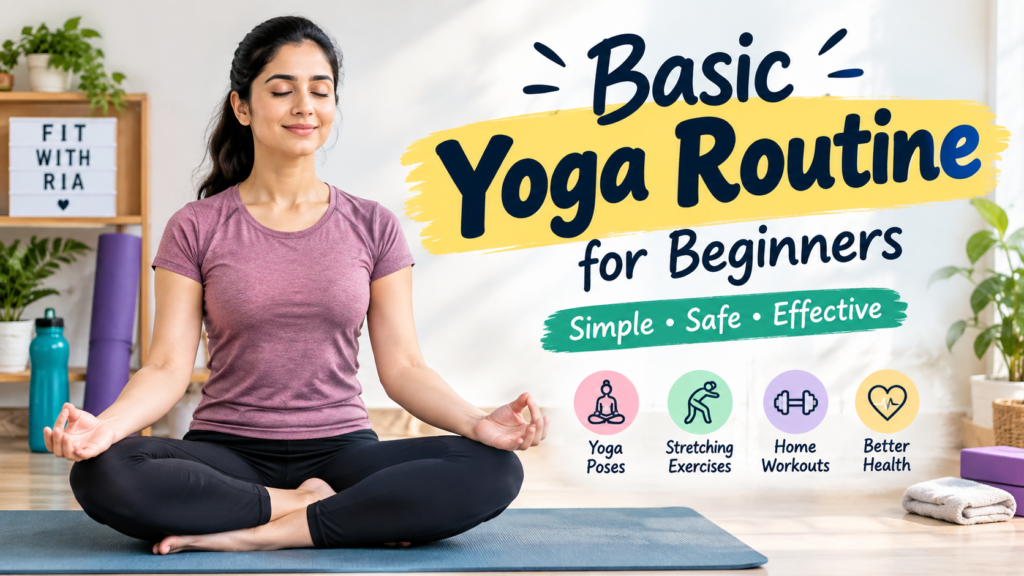
Fortunately, starting a fitness journey does not have to mean spending hours at the gym or following a difficult workout plan. A simple basic yoga routine can be a comfortable way to introduce movement, stretching, balance, breathing, and mindfulness into your day.
For beginners, yoga can be combined with walking, cardio, bodyweight exercises, stretching, and basic strength training to create a balanced fitness routine. You do not necessarily need expensive equipment or a gym membership. Many easy exercises for beginners can be performed at home with little or no equipment.
Whether your goal is to improve flexibility, become more active, support healthy weight management, or simply develop a consistent routine, starting small can make exercise easier to maintain.
According to the World Health Organization (WHO), adults should aim for 150–300 minutes of moderate-intensity aerobic physical activity per week, or an equivalent amount of vigorous activity, along with muscle-strengthening activities on at least two days each week. WHO also recommends that inactive people begin with smaller amounts and gradually increase their activity.Whether your goal is to improve flexibility, become more active, support healthy weight management, or simply develop a consistent routine, starting small can make exercise easier to maintain. Therefore, focus on building a routine that feels comfortable and realistic for your lifestyle.
According to the World Health Organization (WHO), adults should aim for 150–300 minutes of moderate-intensity aerobic physical activity per week, or an equivalent amount of vigorous activity, along with muscle-strengthening activities on at least two days each week. In addition, WHO recommends that inactive people begin with smaller amounts and gradually increase their activity.
What Is a Basic Yoga Routine?
A basic yoga routine is a beginner-friendly sequence of simple yoga movements, stretches, breathing exercises, and relaxation techniques.
However, unlike an advanced yoga session, a beginner routine does not require difficult poses. The focus should be on comfortable movement, controlled breathing, body awareness, and proper form.
A simple routine may include:
- Gentle warm-up movements
- Easy yoga poses
- Simple stretching exercises
- Breathing exercises
- Basic balance movements
- A short relaxation period
You can practice yoga in the morning, evening, or at another convenient time. However, consistency is generally more useful than trying to complete a difficult routine once in a while.
Benefits of a Basic Yoga Routine
Yoga can be one part of an overall active lifestyle. Regular physical activity can support cardiovascular fitness, muscular fitness, bone health, healthy weight management, and mental well-being.
A beginner yoga routine may help you:
- Improve flexibility
- Develop better body awareness
- Support mobility
- Practice controlled breathing
- Reduce stiffness from long periods of sitting
- Build a consistent exercise habit
- Add gentle movement to your daily routine
- Complement strength and cardio workouts
Remember that yoga is only one form of physical activity. Walking, cycling, dancing, strength exercises, and other activities can also contribute to your weekly movement.
10 Simple Yoga Exercises for Beginners
If you are completely new to yoga, begin with comfortable movements and avoid forcing your body into a position.
1. Mountain Pose
Mountain Pose is a simple standing position that can help you focus on posture and breathing.
Stand comfortably with your feet about hip-width apart. Keep your shoulders relaxed, gently lengthen your spine, and take slow breaths.
Hold the position for around 20–30 seconds while focusing on your breathing.
2. Cat-Cow Stretch
Cat-Cow is a gentle movement that can be included in a beginner routine.
Start on your hands and knees. Slowly alternate between gently rounding your back and extending it while coordinating the movement with your breathing.
Perform around 6–10 comfortable repetitions.
3. Child’s Pose
Child’s Pose is commonly used as a gentle resting and stretching position.
Kneel on your mat and slowly move your hips toward your heels while extending your arms forward or resting them comfortably.
Stay for several slow breaths.
4. Downward-Facing Dog
Downward-Facing Dog can provide a gentle stretch through the back of the body.
Start on your hands and knees, then lift your hips upward while keeping your movement controlled.
If your legs feel tight, slightly bend your knees rather than forcing them straight.
5. Cobra Pose
Lie on your stomach with your hands near your shoulders. Gently lift your chest while keeping the movement comfortable.
Do not force your lower back into a deep bend.
6. Tree Pose
Tree Pose is a simple balance exercise.
Stand tall and place one foot against the opposite leg at a comfortable height. Keep your hands together or use a wall for support if needed.
Repeat on both sides.
7. Seated Forward Stretch
Sit comfortably with your legs extended or slightly bent. Slowly lean forward only as far as comfortable.
The goal is not to touch your toes. The goal is controlled movement and a gentle stretch.
8. Butterfly Stretch
Sit with the soles of your feet together and allow your knees to move outward.
Keep your spine comfortable and avoid pushing your knees down forcefully.
9. Gentle Spinal Twist
Sit comfortably and rotate your upper body gently to one side.
Keep the movement controlled and avoid forcing the twist.
Repeat on both sides.
10. Easy Relaxation Pose
Finish your routine by lying comfortably on your back or sitting in a relaxed position.
Take slow breaths for a few minutes and allow your body to settle.
Easy Stretching Exercises for a Basic Yoga Routine
Along with yoga, easy stretching exercises can help you include more mobility-focused movement in your day.
Some basic stretching exercises include:
- Neck movements
- Shoulder rolls
- Arm stretches
- Chest stretches
- Side stretches
- Hamstring stretches
- Calf stretches
- Hip stretches
- Gentle spinal rotations
Stretching should feel comfortable rather than painful. Avoid bouncing aggressively during a stretch.
If you sit for long periods while studying or working, short movement breaks can also help you avoid staying inactive for too long.Stretching should feel comfortable rather than painful. Therefore, avoid bouncing aggressively during a stretch. In addition, if you sit for long periods while studying or working, short movement breaks can help you avoid staying inactive for too long.
Basic Yoga Routine for Beginners at Home
One advantage of yoga is that you can practice many beginner movements at home.
Here is a simple 15–20 minute structure:
| Section | Time |
|---|---|
| Deep breathing | 2 minutes |
| Gentle warm-up | 3 minutes |
| Mountain Pose | 1 minute |
| Cat-Cow | 2 minutes |
| Child’s Pose | 2 minutes |
| Downward-Facing Dog | 2 minutes |
| Cobra Pose | 1 minute |
| Butterfly Stretch | 2 minutes |
| Gentle relaxation | 3–5 minutes |
You can adjust the duration according to your fitness level.
Beginner Bodyweight Exercises to Complement Yoga
Yoga does not have to be your only exercise.
Beginner body weight exercises can help you develop basic strength without gym equipment.
Some simple options include:
Bodyweight Squats
First, stand with your feet comfortably apart and lower your hips slowly. Then, return to a standing position.
Wall Push-Ups
Place your hands against a wall and perform controlled push-up movements.
Glute Bridges
Lie on your back with your knees bent. Lift your hips slowly and lower them with control.
Standing Calf Raises
If necessary, hold a stable surface for support. Then, slowly raise your heels before lowering them.
Modified Plank
Start with a comfortable plank variation and focus on maintaining good body alignment.
These are examples of basic exercises for beginners.Instead, start with a manageable number of repetitions rather than trying to do too much on your first day.
Best Cardio Exercises at Home for Beginners
In addition, cardio can complement a basic yoga routine by increasing your overall physical activity.
Some best cardio exercises at home for beginners include:
- Brisk walking
- Marching in place
- Step-ups
- Dancing
- Low-impact jumping jacks
- Stationary cycling
- Beginner aerobic routines
If you are new to exercise, low-impact movements can be a practical starting point.
For example, you can try:
5 minutes: Easy warm-up
10 minutes: Brisk walking or marching
5 minutes: Gentle stretching
As your fitness improves, you can gradually increase your activity.
Basic Gym Routine for Beginners
However, if you prefer exercising at a gym, you do not need to begin with complicated machines or advanced programs.
A basic gym routine can include simple movements that train different muscle groups.
Example Beginner Gym Session
Warm-up – 5–10 minutes
- Walking
- Light cycling
- Gentle mobility movements
Strength training
- Leg press
- Seated row
- Chest press
- Lat pulldown
- Bodyweight squats
- Light dumbbell exercises
Cardio – 10–15 minutes
- Treadmill walking
- Cycling
- Elliptical
Cool-down – 5 minutes
- Easy walking
- Gentle stretching
The appropriate weight and number of repetitions depend on your fitness level, technique, and goals.
Daily Workout Routine at Gym: A Simple Structure
A daily workout routine at gym does not necessarily mean training intensely every day.
Your weekly routine can include different types of exercise and recovery.
For example:
| Day | Activity |
|---|---|
| Monday | Full-body strength + stretching |
| Tuesday | Cardio + basic yoga routine |
| Wednesday | Strength training |
| Thursday | Walking + easy stretching |
| Friday | Full-body strength + cardio |
| Saturday | Yoga + light activity |
| Sunday | Rest or gentle movement |
This type of structure allows you to combine strength, cardio, flexibility, and recovery.
Basic Workout Plan for Women
A basic workout plan for women can follow the same fundamental principles as a beginner fitness plan: strength, cardiovascular activity, mobility, and recovery.
A simple weekly structure could include:
- 2–3 days of strength training
- 2–3 days of cardio or active movement
- 2–4 short yoga or stretching sessions
- Finally, make sure to include at least some recovery time in your weekly routine
Therefore, the exact plan should be adjusted according to your fitness level, goals, schedule, and individual needs.
There is no need to choose exercises based only on gender. Beginners should select movements that match their current ability and progress gradually.
Best Home Workout Exercises for Beginners
Similarly, if you prefer working out at home, you can build a useful routine without a large collection of equipment.
Some best home workout exercises include:
- Squats
- Wall push-ups
- Glute bridges
- Lunges or supported lunges
- Marching in place
- Step-ups
- Planks
- Bird dogs
- Calf raises
- Basic yoga poses
These exercises can be combined into a simple home workout.
Example Home Workout
Complete 2 rounds:
- 10 squats
- 8 wall push-ups
- 10 glute bridges
- 10 alternating step-backs
- 20–30 seconds of marching
- 20 seconds of a comfortable plank variation
Additionally, take a short rest between exercises when needed.
Basic Core Exercises for Beginners
Your core includes more than just the abdominal muscles. Beginner-friendly core movements can include:Importantly, your core includes more than just the abdominal muscles.
- Bird dog
- Dead bug
- Glute bridge
- Modified plank
- Heel taps
- Standing knee raises
These are useful basic core exercises because they can be modified for different fitness levels.
Best Ab Exercises at Home
If you are looking for best ab exercises at home, focus on controlled movements instead of doing a large number of repetitions.
Options include:
- Dead bug
- Heel taps
- Bent-knee leg raises
- Modified plank
- Bird dog
- Slow mountain climbers
Remember that doing abdominal exercises alone does not specifically remove belly fat. Overall physical activity, nutrition, sleep, and long-term habits are important parts of healthy weight management.
Best Chest Home Exercises
You can also train your chest at home using simple movements.
Some best chest home exercises for beginners include:
Wall Push-Ups
A good starting point for people who are not yet comfortable with floor push-ups.
Incline Push-Ups
Use a stable elevated surface and perform controlled push-ups.
Knee Push-Ups
Once you are comfortable with incline variations, knee push-ups can provide another progression.
Regular Push-Ups
As your strength improves, you may progress toward standard push-ups.
Always prioritize good technique over completing a high number of repetitions.
Basic Gym Exercises for Beginners
If you are joining a gym for the first time, focus on learning movement patterns rather than immediately lifting heavy weights.
Some basic gym exercises include:
- Squats
- Leg press
- Chest press
- Seated row
- Lat pulldown
- Dumbbell shoulder press
- Cable exercises
- Light dumbbell movements
A trainer can help you learn how to use unfamiliar equipment safely.
A basic gym program should also include rest and progression instead of training every muscle intensely every day.
Best Gym Workout Routine for Weight Loss
People often search for the best gym workout routine for weight loss, but there is no single routine that works identically for everyone.
A practical gym routine can combine:
- Strength training
- Cardio
- Regular daily movement
- Healthy eating habits
- Adequate recovery
For example, a beginner might start with full-body strength training two or three times per week and add moderate cardio on other days.
The goal should be to create a routine that can realistically be followed for months rather than choosing the hardest workout available.
Easy At-Home Exercises for Busy Days
You do not always need a full workout session.
On busy days, try a short easy at home exercise routine:
- 1 minute marching
- 10 squats
- 8 wall push-ups
- 10 glute bridges
- 20 seconds standing knee raises
- 2 minutes stretching
Repeat once or twice depending on your time and fitness level.
Even short movement sessions can help you become more active. WHO notes that some physical activity is better than none and recommends that inactive people begin with smaller amounts and gradually build up.
Simple Exercises for Beginners: How to Progress
One of the biggest mistakes beginners make is increasing exercise too quickly.
Instead, use a gradual approach.
Week 1
Focus on learning basic movements.
Week 2
Increase repetitions slightly if your body feels comfortable.
Week 3
Add another round or a few extra minutes of cardio.
Week 4
Increase difficulty gradually or introduce new exercises.
You do not need to make every workout harder.
Progress can also mean improving your technique, consistency, range of motion, balance, or control.
Basic Yoga Routine + Home Workout Plan
If you want to combine different types of exercise, this simple structure can work as a starting point:
Monday: Basic yoga routine + walking
Tuesday: Beginner strength workout
Wednesday: Cardio + simple stretching exercises
Thursday: Basic yoga routine + core exercises
Friday: Gym or home strength workout
Saturday: Light cardio + stretching
Sunday: Rest or gentle movement
This approach gives you flexibility to exercise at home or in the gym.
Common Beginner Workout Mistakes to Avoid
Starting a fitness journey is exciting, but avoid these common mistakes.
1. Doing Too Much Too Soon
Your body needs time to adapt.
2. Ignoring Warm-Up
A few minutes of gentle movement can prepare you for your workout.
3. Focusing Only on Weight Loss
Fitness includes strength, mobility, cardiovascular health, energy, and overall well-being.
4. Using Poor Form
Quality movement is more important than rushing through repetitions.
5. Skipping Recovery
Rest is an important part of a sustainable exercise routine.
6. Comparing Yourself With Others
Your starting point is different from someone else’s.
7. Changing Your Routine Every Few Days
Give your body and your habits enough time to develop.
How to Make Your Basic Yoga Routine a Daily Habit
Building a habit is often easier when the routine is simple.
Try these strategies:
- Choose a fixed time
- Keep your yoga mat ready
- Start with 10–15 minutes
- Use beginner-friendly poses
- Combine yoga with another activity
- Track your consistency
- Increase duration gradually
- Focus on how you feel rather than perfection
You can practice a basic yoga routine in the morning, during a break, after work, or before bed depending on what fits your lifestyle.
Yoga, Home Workout or Gym: Which Should You Choose?
You do not have to choose only one.
| Option | Useful For | Equipment |
|---|---|---|
| Yoga | Flexibility, mobility, relaxation | Mat |
| Home workout | Strength and general fitness | Little or none |
| Gym | Strength and structured training | Gym equipment |
| Walking/Cardio | Cardiovascular activity | Usually none |
| Stretching | Mobility and flexibility | Usually none |
The most useful option is often the one you can perform consistently and safely.
Final Thoughts
A basic yoga routine can be a simple starting point for anyone who wants to become more active. You can combine yoga with easy stretching exercises, beginner bodyweight exercises, cardio, basic gym exercises, and simple home workouts to create a balanced fitness routine.
You do not need to start with an advanced workout. Start with movements you can perform comfortably, learn proper technique, and gradually increase your activity.
For adults, WHO recommends 150–300 minutes of moderate-intensity aerobic activity per week, along with muscle-strengthening activities on at least two days per week. If you currently do very little physical activity, starting with smaller amounts and building gradually is recommended.
Most importantly, make your routine realistic. A simple workout that you can continue consistently is more practical than an extremely difficult plan that you cannot maintain.
Start Your Fitness Journey With Fit With Ria
Your fitness journey does not have to be complicated. Start with a basic yoga routine, add simple exercises, stay active throughout the day, and build healthy habits step by step.
At Fit With Ria, the goal is to make fitness simple, practical, and easier to understand for beginners.
Start small. Stay consistent. Keep moving.
Your healthier routine can begin today.